From the workshops of Central Europe came a language of colour, cutting and light that travelled far beyond Bohemia.
Bohemian crystal is high-quality decorative glass associated with the historic region of Bohemia, now part of the Czech Republic. The name describes a glassmaking tradition rather than one fixed material formula or pattern. Bohemian work became known for clear, hard glass suited to detailed cutting and engraving, along with coloured overlays, painted decoration, chandeliers, beads and precisely polished facets. A piece labelled “Bohemian crystal” is not necessarily lead crystal, handmade or antique; those qualities must be confirmed separately.
Where does the name “Bohemian crystal” come from?
The name comes from Bohemia, a historic region that forms much of the western Czech Republic.
Glass has been made across the Czech lands for centuries, with northern Bohemia becoming one of its most closely associated production centres. The Museum of Glass and Jewellery in Jablonec nad Nisou presents the story of Bohemian glass across seven centuries, while the region now promoted as the Crystal Valley still contains working glasshouses, cutting rooms, schools and jewellery workshops.
The word therefore began as a reference to origin. Over time, it also came to suggest a recognisable standard of decorative glass: brilliant surfaces, disciplined cutting, elaborate engraving and a close relationship between glassmaking and jewellery production.
That broader use can create confusion. “Bohemian” does not describe the free-spirited interior style now called boho. In glassware, it refers to a geographic and craft tradition.
Is Bohemian glass the same as Bohemian crystal?
The two expressions overlap, but they are not exact synonyms.
Bohemian glass is the broader term. It can include drinking vessels, decorative objects, beads, jewellery components, sculptures, chandeliers and other forms produced within the Czech glassmaking tradition.
Bohemian crystal usually refers to the clearer, more brilliant and often more elaborately cut part of that tradition. In ordinary retail language, however, the word “crystal” is not always used with strict technical precision.
This distinction matters because crystal is not one universally identical substance. European rules divide crystal glass into categories according to composition, density and refractive properties. Under the relevant European directive, higher categories include full lead crystal and lead crystal, while other crystal and crystalline categories may use combinations of lead, zinc, barium or potassium oxides.
A Czech crystal vessel may therefore be lead crystal, but it does not have to be. Czech makers also produce lead-free crystal intended to retain clarity, hardness and suitability for detailed cutting.
| Term | What it usually means | What it does not guarantee |
|---|---|---|
| Bohemian glass | Glass associated with the historic Czech glassmaking tradition | Crystal composition, hand production or a particular pattern |
| Bohemian crystal | Brilliant decorative glass associated with that tradition, often cut or engraved | Lead content, age or handmade production |
| Lead crystal | Crystal glass containing a regulated proportion of lead oxide | Czech or Bohemian origin |
| Lead-free crystal | Crystal-quality glass using other mineral compositions | Handmade production |
| Cut-to-clear glass | Layered coloured and clear glass cut to reveal contrast | Bohemian origin by itself |
| Czech glass | Modern broad description for glass made in the Czech Republic | One material, technique or style |
What made Bohemian crystal different from other European glass?
One important development was the production of very clear, hard glass that responded particularly well to cutting and engraving.
Official Czech heritage sources describe northern Bohemian glassmakers producing bright, hard crystal-clear glass by the seventeenth century. Its surface could withstand detailed cold working, allowing cutters and engravers to create sharp geometry, pictorial scenes and polished facets that behaved almost like cut stone.
This helped distinguish the Bohemian tradition from Venetian glassmaking, which had become famous for delicacy, fluidity, colour and sophisticated hot-working techniques. The difference should not be reduced to a simple rivalry: both traditions changed over centuries and borrowed from wider European developments.
Still, their best-known visual instincts were different. Venetian glass often celebrated what could be done while the material remained hot. Bohemian crystal gained particular authority from what could be done after the vessel had cooled.
The form left the furnace unfinished in one sense. The cutting room completed its identity.
Why is cutting so closely associated with Bohemian crystal?
Cutting transforms the way a glass object receives and returns light.
The process takes place after the vessel has been formed and annealed. A cutter removes material with rotating wheels and abrasive compounds, beginning with coarser work and moving toward finer grinding and polishing. Proper polishing restores transparency to the cut surfaces; without it, the decoration can remain pale or cloudy.
Bohemian cutters developed an extensive vocabulary of stars, fans, diamonds, lenses, cross-cuts and repeating geometric fields. On a well-designed piece, these marks do more than cover the surface. They alter the apparent proportions of the object.
Vertical cuts can make a vessel seem taller. A broad diamond field can give a bowl more visual weight. Small repeating cuts create frequent points of brilliance, while larger polished facets produce slower, more architectural reflections.
The difficulty lies in maintaining order around a curved form. A pattern that appears exact when drawn flat must be adjusted as it travels around a bowl, narrows toward a foot or meets the shoulder of a decanter.
Precision is not simply the absence of error. It is the successful negotiation of the vessel’s geometry.
What is the difference between cutting and engraving?
Cutting usually creates broader facets and geometric decoration. Engraving works more finely into the surface.
The Corning Museum of Glass defines engraving as cutting into an annealed glass object, traditionally with a rotating copper wheel and abrasive or with a diamond point. This can produce lettering, foliage, portraits, animals and detailed narrative scenes.
The two techniques can appear on the same object.
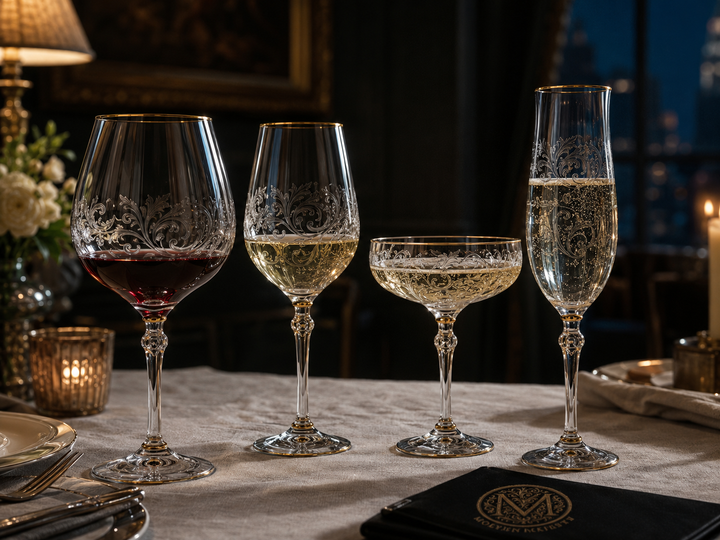
A goblet may have a deeply cut lower bowl that creates brilliance from a distance, then carry a delicate engraved panel intended to be examined closely. One responds first to the room; the other reveals itself to the hand and eye.
Painting and gilding also belong to the wider Bohemian decorative tradition. So do beads, imitation gemstones, chandeliers and sculptural studio glass. The reputation of the region cannot be reduced to one diamond pattern, even though heavily cut crystal remains its most familiar international image.
What is coloured cut-to-clear Bohemian crystal?
Cut-to-clear glass is made by combining layers of contrasting colour, then removing parts of the outer layer so that the clearer glass underneath becomes visible.
The coloured layer may be created through casing or overlaying. In casing, one layer of hot glass is applied over another and the two are shaped together. Once the piece has cooled, selected areas of the upper colour can be cut away.
This reverses the usual idea of ornament.
Nothing is painted into the transparent openings. The pattern appears because colour has been removed. A ruby surface gives way to clear diamonds. Emerald glass opens into polished lenses. Black overlay may appear nearly opaque until deep cuts expose the colourless structure beneath it.
The thickness of the coloured layer matters. If it is inconsistent, the revealed pattern may change in tone or lose definition. The cutter must understand both the planned geometry and the material hidden beneath the visible surface.
Cut-to-clear decoration is strongly associated with Bohemian and Czech glass, but it is a technique rather than a certificate of origin. Layered and cut glass has been produced in other glassmaking regions as well.
Is all Bohemian crystal handmade?
No. The label alone does not establish how the piece was made.
The Czech glass industry includes small studios, historic glassworks, large manufacturers and highly automated facilities. Some objects are free-blown. Others are blown into moulds, pressed, machine-formed or produced through a mixture of industrial and manual stages. Cutting, polishing, painting or engraving may then be carried out by hand or machine.
Even within one object, production can be shared between processes. A vessel may be formed with mechanical assistance and hand-cut afterward. A handblown blank may use a mould to control its initial profile. Neither fact can be discovered from the phrase “Bohemian crystal” alone.
Handmade glass production remains a living part of Czech culture. In 2023, UNESCO inscribed the knowledge, craft and skills of handmade glass production on its Representative List of the Intangible Cultural Heritage of Humanity through a joint nomination that included Czechia and five other European countries. UNESCO describes the practice as a combination of hot and cold techniques requiring highly developed skill and close cooperation between specialists.
That recognition protects a body of knowledge. It does not mean every glass object made in the Czech Republic is handmade.
Does Bohemian crystal always contain lead?
No. Bohemian crystal may be leaded or lead-free.
Lead oxide was historically valued in crystal because it can increase density, brilliance and workability. European law reserves particular descriptions for crystal categories that meet defined compositional and physical standards. Full lead crystal, for example, requires a higher lead-oxide content than the lead crystal category below it.
Modern Czech glassmakers also work with lead-free compositions. These may use other oxides to achieve clarity, refractive quality and a surface capable of detailed cutting.
For a buyer, “lead-free” should not be interpreted as ordinary or inferior glass. Nor should the presence of lead be treated as proof that a piece was made in Bohemia, cut by hand or produced to a high standard.
Composition answers one question. Craft, finishing and provenance answer others.
How can you identify authentic Bohemian crystal?
The most reliable evidence is documented origin, not a single home test.
Look for the maker’s mark, original label, packaging, certificate, invoice or trustworthy seller description. The information should distinguish between Czech-made, handmade, hand-cut, lead crystal and lead-free crystal rather than blending those claims together.
When examining the object itself, consider:
- Clarity: The glass should suit the intended design. Unwanted haze or poorly polished cuts may indicate wear or weak finishing.
- Cutting: Facets should meet with purpose and follow the vessel’s proportions.
- Polishing: Finished cuts should interact cleanly with light rather than appearing uniformly chalky.
- Stability: The object should rest securely on its base.
- Rim finish: Drinking edges should be smooth and properly resolved.
- Decoration: Engraving, gilding or colour should appear integrated with the form.
- Consistency of the claim: A seller calling something “antique handmade Bohemian lead crystal” should be able to support each part of that description.
Weight and sound can contribute to an assessment, but neither proves origin.
A dense glass may feel substantial, and some crystal produces a prolonged note when tapped. Shape, thickness, composition and condition all influence sound. A machine-made crystal glass can ring. A genuine handmade piece with a thick wall or small form may produce a shorter note.
The object should be read as a whole.
Is antique Bohemian crystal more valuable?
Age alone does not determine value.
The maker, condition, rarity, quality of cutting, historical importance, completeness of a set and strength of provenance all matter. A damaged nineteenth-century object may be less desirable than an excellent later piece from a recognised workshop. A common pattern can remain beautiful without being especially scarce.
Watch for chips along rims, feet and raised cuts. Inspect stoppers and handles closely. Cloudiness inside a decanter may come from removable deposits, but it can also result from permanent surface damage. Repaired cracks, replacement stoppers and extensive grinding can affect value.
Original labels can be useful, although labels can also be moved between objects. They should support the evidence of the piece rather than replace it.
For an important purchase, specialist assessment is more reliable than an online checklist.
What makes good Bohemian crystal distinctive today?
The strongest contemporary work does not merely repeat historic patterns.
Czech glassmaking remains active across traditional tableware, jewellery, lighting, architecture and studio art. Historic techniques continue beside modern furnaces, computer-assisted design and specialised production machinery. Some makers preserve familiar cut patterns; others use the material at monumental scale or reduce the decoration until only a few decisive cuts remain.
The continuity lies less in one style than in the fluency of the workshops.
Glass may pass through several skilled hands before completion: the glassmaker who forms it, the cutter who establishes the geometry, the engraver who adds detail and the polisher who restores brilliance to every altered surface. UNESCO’s description of handmade glass production stresses this dependence on preceding steps and the team discipline it requires.
The final object can look effortless because the complexity has been absorbed by the people who made it.
From the atelier: how to read a cut crystal design
Begin with the silhouette before looking at the pattern.
A successful cut design should respect the vessel beneath it. On a wide bowl, the decoration may spread outward and reinforce the open rim. On a decanter, vertical cuts can draw the eye toward the neck. A footed vessel needs a clear transition between its decorated body, stem and base.
Then turn the object slowly.
The pattern should remain coherent as it moves out of direct view. Lines that appear balanced at the front should not collapse awkwardly at the sides. Repeated motifs should meet cleanly where the design closes around the vessel.
On coloured cut-to-clear glass, examine the contrast between the overlay and the exposed clear areas. The revealed cuts should feel intentional rather than scattered. Their depth should suit the thickness of the coloured layer.
Finally, notice what happens when the object is no longer under showroom lighting.
Good cut glass does not require a spotlight to exist. Near a window, it should hold quiet reflections. At dinner, candlelight should find particular edges and disappear into others. The piece changes with the room without losing its form.
How does Bohemian crystal influence Molten Majesty?
Molten Majesty draws from the wider cut-glass tradition through colour, deep surface work and the use of clear geometry beneath an overlay.
That influence should be described accurately. Molten Majesty is not presented as a historic Czech glass house merely because some of its designs use techniques associated with Bohemian crystal. Place of production and design influence are different claims.
The useful connection lies in a shared approach to decoration.
Colour is treated as a layer with depth rather than a flat coating. Cutting is used to reveal structure, control reflection and reshape the apparent proportions of a vessel. A bowl is not considered finished when its silhouette is formed; its surface becomes a second field of design.
This is how a historic craft language remains relevant. It can be studied, respected and carried into new objects without borrowing a provenance that does not belong to them.
What should you look for when buying Bohemian crystal?
Begin by asking the seller to be precise.
Where was the piece made? Is it handblown, mould-blown, pressed or machine-formed? Was the decoration cut by hand? Is the material lead crystal or lead-free crystal? Is the pattern contemporary, vintage or antique?
Then judge whether the object succeeds on its own terms.
A highly decorated piece should remain balanced. A minimal piece should depend on exceptional proportion and finish. Colour should be even where intended. Clear cuts should be polished properly. The base should sit securely, and functional pieces should feel comfortable to hold.
Do not buy the label in place of the object.
“Bohemian crystal” carries centuries of history, but the words cannot guarantee that every item bearing them has inherited the best of that history. The distinguishing qualities remain visible in the glass itself: control of material, confidence of cutting and an understanding of how light completes the design.