There are dozens of historical and regional drinking-glass forms, but roughly 20 shapes account for most of what appears in contemporary homes, bars and restaurants. The fastest way to identify them is by comparison: a Collins is taller and narrower than a highball, a Double Old Fashioned is larger than a rocks glass, and a Nick & Nora encloses a cocktail more closely than a Martini glass.
The capacity ranges below are typical modern commercial sizes, not legal definitions. Manufacturers vary considerably. Libbey, Riedel and hospitality suppliers all sell several capacities under the same glass name, which is why shape matters at least as much as the number printed on the box.
The drinking glass chart
| Glass type | Typical capacity | What it is actually for | Most often confused with |
|---|---|---|---|
| Water tumbler | 10–16 oz / 296–473 mL | Water, soda, juice, everyday drinks | Highball |
| Water goblet | 12–18 oz / 355–532 mL | Water at a stemmed table setting | Wine glass |
| Rocks / Old Fashioned | 7–10 oz / 207–296 mL | Spirits, large ice, short cocktails | Double Old Fashioned |
| Double Old Fashioned | 10–14 oz / 296–414 mL | Larger short cocktails and more ice | Rocks glass |
| Highball | 8–12 oz / 237–355 mL | Spirit plus mixer over ice | Collins |
| Collins | 10–14 oz / 296–414 mL | Longer, taller mixed drinks | Highball |
| Shot glass | 1.5–2 oz / 44–59 mL | Small straight spirit serves | Shooter |
| Glencairn | 6.75 oz / 200 mL | Whisky nosing and tasting | Snifter |
| Brandy snifter | 9–16 oz / 266–473 mL | Cognac, brandy, aromatic spirits | Glencairn |
| Nick & Nora | 4.5–7 oz / 133–207 mL | Spirit-forward cocktails served up | Martini |
| Coupe | 6–10 oz / 177–296 mL | Cocktails served up, sparkling wine | Martini |
| Martini | 5–10 oz / 148–296 mL | Martinis and other strained cocktails | Coupe |
| Margarita | 9–12 oz / 266–355 mL | Margaritas, especially with a salted rim | Coupe |
| Hurricane | 15–20 oz / 444–591 mL | Long tropical cocktails | Collins |
| Red wine glass | 14–26 oz / 414–769 mL | Red wine with room above the pour | Water goblet |
| White wine glass | 9–15 oz / 266–444 mL | Chilled white and rosé wines | Small red wine glass |
| Champagne flute | 6–10 oz / 177–296 mL | Sparkling wine, especially toasts | Champagne tulip |
| Pint / pub glass | 16 US oz / 473 mL or 20 imperial oz / 568 mL | Beer and general bar service | Pilsner |
| Pilsner glass | 12–20 oz / 355–591 mL | Pilsners and pale lagers | Weizen |
| Weizen glass | 16–20 oz / 473–591 mL | Wheat beer and its substantial foam head | Pilsner |
The ranges draw on current hospitality guides and manufacturer catalogues. For example, commercial rocks glasses are commonly offered around 7 to 10 ounces, Double Old Fashioned glasses around 12 ounces, highballs around 8 to 12 ounces and Collins glasses around 10 to 14 ounces.
Highball vs Collins: the difference is mostly proportion
A highball is a tall straight-sided glass, commonly around 8 to 12 ounces. It is intended for drinks built over ice with a substantial mixer, such as a gin and tonic, whisky highball or rum and cola. WebstaurantStore describes the traditional highball as shorter and wider than a Collins.
A Collins glass is usually taller, narrower and slightly larger, around 10 to 14 ounces. That extra height suits drinks such as the Tom Collins, mojito and other long cocktails that need room for ice and mixer.
Put the two side by side and the distinction is immediate. Remove one from the room and bartenders have been known to become considerably more flexible about terminology.
Molten Majesty's Altiera Highball is a clear example of the highball silhouette: tall walls, a weighted lower section and enough vertical space for ice and a mixed drink.
Rocks vs Old Fashioned vs lowball
These are mostly overlapping names.
A rocks glass, Old Fashioned glass and lowball generally refer to the same family: a short, broad tumbler with a substantial base. Typical capacities sit around 7 to 10 ounces, although larger versions are common. WebstaurantStore itself treats rocks, Old Fashioned and lowball as interchangeable names.
The form suits:
- Whisky neat or over ice
- An Old Fashioned
- Negroni
- Sazerac
- Other compact cocktails
The broad opening accommodates a large ice cube and gives the hand easy access for stirring or muddling.
A Double Old Fashioned, usually around 10 to 14 ounces, is simply the larger member of the family. Libbey's current catalogues include 12 and 13.25-ounce Double Old Fashioned examples beside 7 to 10-ounce rocks glasses.
This is one of those cases where the word double describes the glass more reliably than it describes what should be poured into it.
The Altiera Tumbler sits naturally within this short-tumbler family.
Coupe vs Martini vs Nick & Nora
All three are stemmed glasses commonly used for cocktails strained from ice and served without ice in the finished drink. Their geometry is very different.
Coupe
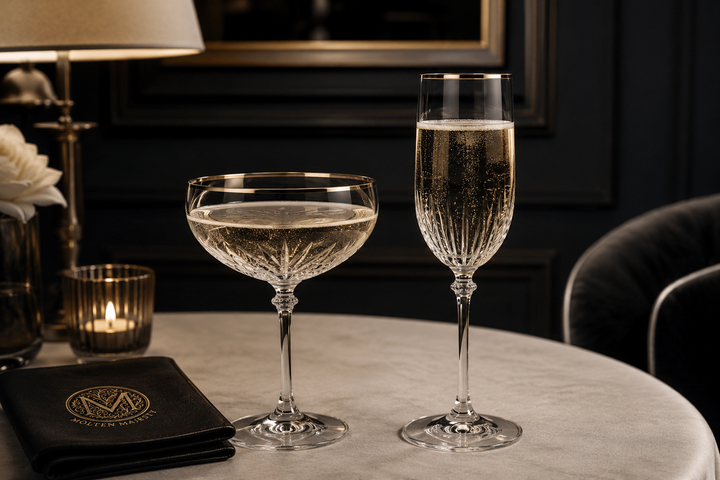
The coupe has a broad, shallow, rounded bowl. Modern examples commonly fall around 6 to 10 ounces.
It works particularly well for Daiquiris, Gimlets, Manhattans and similar drinks served up. Its broad form also has a long association with sparkling wine, although Champagne loses dissolved carbon dioxide faster in a coupe than in a narrower flute.
The Platora Coupe Glass is Molten Majesty's clearest example of the form.
For the sparkling-wine question, see Champagne Coupe vs Flute: Shape, Bubbles and Occasion.
Martini glass
A Martini glass has a conical V-shaped bowl rather than the coupe's rounded one. Commercial examples vary widely, roughly from 5 to 10 ounces. Libbey catalogues include Martini and cocktail glasses across that range.
The wide opening presents a Martini, Cosmopolitan or similar drink very directly. It also brings the liquid rather close to the edge, which is elegant while stationary and rather less philosophical when someone walks quickly across the room.
Nick & Nora
The Nick & Nora is smaller and more enclosed. Its bowl has higher sides and a narrower opening, typically around 4.5 to 7 ounces.
Riedel describes the form as suited to spirit-forward cocktails such as Martinis, Vespers and Manhattans, with the narrower opening making it less spill-prone than a traditional Martini glass. Its current examples range from about 140 to 198 mL.
Choose a coupe for breadth, Martini for the classic V silhouette and Nick & Nora for a smaller, more contained serve.
Margarita vs coupe
A Margarita glass is recognisable by its stepped or double-bowl profile: a smaller lower bowl expands into a broad upper rim.
Commercial examples commonly hold 9 to 12 ounces.
The wide rim provides room for salt or sugar. That is the functional clue separating it from a coupe, whose bowl curves smoothly outward without the characteristic step.
A Margarita can certainly be served in a coupe. The drink does not file a complaint. The named Margarita glass simply gives garnish more territory.
Hurricane vs Collins
Both are tall cocktail glasses, but the Hurricane is curved rather than straight.
Its silhouette usually narrows near the lower bowl, swells outward through the body and may flare slightly at the rim. Capacities often land around 15 to 20 ounces, leaving room for crushed ice, juice and the several ingredients expected of tropical drinks. Commercial catalogues commonly offer Hurricane vessels in exactly that range.
A Collins is architectural. A Hurricane has a waist.
Use the latter for Hurricanes, Piña Coladas and generous tropical drinks where visual presentation is part of the serve.
Shot glass vs shooter
A traditional shot glass is short and small, commonly around 1.5 to 2 ounces, or approximately 44 to 59 mL. Commercial glass lines regularly offer both capacities.
A shooter is often taller and may hold the same amount or somewhat more. The terminology varies more than the underlying purpose.
The important distinction is between glass capacity and spirit measure. A 2-ounce glass can hold a 1.5-ounce standard pour with useful space at the rim. The glass size does not establish the legal serving measure in a particular country or venue.
Glencairn vs snifter
Both narrow toward the top, but they come from different traditions.
Glencairn
The standard Glencairn whisky glass has a compact tulip bowl over a short solid foot rather than a conventional stem. The official Glencairn site lists the standard capacity at 6.75 ounces, about 200 mL.
That sounds large beside a typical whisky pour because most of the glass is intentionally empty. The rounded lower bowl gives the spirit surface area, while the narrower opening creates a concentrated nosing space.
Brandy snifter
The snifter has a much broader balloon bowl, short stem and narrow upper opening. Commercial examples vary widely, often around 9 to 16 ounces.
It is traditionally associated with brandy and Cognac, though it also appears in stronger beer service.
The simplest visual test is the base. A Glencairn has a sturdy foot and taller tulip. A snifter looks as though someone gave a balloon bowl a very short stem.
Water tumbler vs water goblet
A water tumbler is stemless. Capacities around 10 to 16 ounces are common, and the same basic form may be labelled beverage glass, cooler or tumbler depending on the manufacturer. Libbey's commercial lines show precisely this overlap.
A water goblet places the bowl on a stem and usually holds roughly 12 to 18 ounces. Fortessa, for example, lists stemmed water goblets around 17.4 ounces, while other hospitality ranges include 12 and 18-ounce versions.
A goblet is sometimes mistaken for a wine glass because both have a foot, stem and bowl. Water goblets are often broader, more substantial and less specialised in their bowl shape.
Molten Majesty's Altiera collection contains all three foundational table forms: Tumbler, Highball and Goblet.
Red wine glass vs white wine glass
The broad rule is scale.
A red wine glass usually has a larger bowl, commonly around 14 to 26 ounces. Large contemporary examples may go beyond this. The extra capacity is primarily headspace, not an invitation to pour half the bottle. Hospitality catalogues show red wine bowls ranging from roughly 14 to more than 25 ounces.
A white wine glass is generally smaller, often around 9 to 15 ounces. The reduced bowl volume suits chilled wines and provides a more compact aromatic space.
The subject goes much deeper than red versus white. Bordeaux, Burgundy, Sauvignon and universal bowls all change proportion in specific ways. See The Complete Guide to Wine Glass Shapes for the full comparison.
Champagne flute vs wine glass
A Champagne flute has a tall, narrow bowl, usually around 6 to 10 ounces. Current hospitality ranges commonly fall between about 6 and 10 ounces.
The narrow silhouette reduces the exposed surface compared with a coupe and creates a long visible column for bubbles.
A regular wine glass has a wider bowl and more aromatic space. For complex sparkling wines, a tulip-shaped wine glass can be a very good choice.
The Platora Champagne Flute represents the classic tall form.
Pint glass vs pilsner glass
A US shaker pint is the familiar straight, slightly tapered bar glass with a nominal capacity of 16 US fluid ounces, around 473 mL. Commercial shaker glasses are widely sold at that exact capacity.
The imperial or nonic pint belongs to a different measurement system. A British imperial pint is 20 imperial fluid ounces, about 568 mL. Nonic glasses often have a bulge close to the upper section, improving grip and reducing rim contact when glasses are stacked. WebstaurantStore distinguishes the American and imperial forms in its beer-glass guide.
A pilsner glass is taller and more tapered, often widening toward the mouth. Typical capacities vary substantially, with modern commercial examples around 12 to 20 ounces and larger versions beyond that.
The pilsner's narrow height displays pale beer and rising carbonation. The pint's great talent is being broadly useful and requiring almost no explanation.
Pilsner vs Weizen
This confusion is understandable because both are tall beer glasses.
A pilsner glass is generally straight-sided or gently flared. It remains relatively narrow through most of its height.
A Weizen glass narrows lower down and expands more strongly near the top. The enlarged upper section leaves room for the substantial foam associated with wheat beers. WebstaurantStore specifically distinguishes it from the straighter pilsner form on this basis.
Typical Weizen capacities are around 16 to 20 ounces, with half-litre forms particularly common.
If the top of the glass seems to have made deliberate arrangements for foam, you are probably looking at the Weizen.
Capacity is not the same as pour size
This point prevents a surprising amount of confusion.
A 20-ounce red wine glass is not designed to receive 20 ounces of wine. A 16-ounce snifter does not imply a 16-ounce Cognac service. A 6.75-ounce Glencairn is normally used with only a fraction of that amount.
Capacity describes how much liquid the vessel can physically contain near the rim. Good glass design often depends on leaving much of that volume empty.
The empty space can accommodate:
- Ice
- Foam
- Carbonation
- Aromatic headspace
- Swirling
- A reasonable chance of reaching the table without incident
The final item receives remarkably little attention in technical glassware literature.
From the atelier: identify the silhouette before the name
When a glass arrives at the atelier without a label attached, the name is rarely the first useful question.
Start at the base.
Is it stemmed or stemless? Is the base heavy enough for ice and muddling, or fine enough to belong beneath a wine bowl?
Move upward.
Straight sides suggest a tumbler, highball or Collins. A broad short bowl points toward rocks service. A tulip shape suggests wine or spirits tasting. An open shallow bowl enters coupe territory. A hard V almost announces Martini before the glass has finished arriving.
Then look at capacity and proportion together.
A highball and Collins may hold similar volumes, but one feels broader and more compact. A rocks glass and Double Old Fashioned share a silhouette, with scale doing most of the distinguishing work.
The name should confirm what the form already tells you.
What are the different types of drinking glasses?
The main groups are everyday beverage glasses, cocktail glasses, spirits glasses, wine glasses and beer glasses.
Within those groups, the most common named forms include tumbler, goblet, rocks, Double Old Fashioned, highball, Collins, shot, Glencairn, snifter, Nick & Nora, coupe, Martini, Margarita, Hurricane, red wine, white wine, flute, pint, pilsner and Weizen.
That gives a home bar enough vocabulary to survive most dinner parties without issuing identification cards.
What are the 7 types of glass in order?
There is no official seven-glass hierarchy or required order for drinking glassware.
If the question means seven useful household categories, a practical sequence is:
- Tumbler
- Rocks glass
- Highball
- Wine glass
- Champagne glass
- Cocktail glass
- Beer glass
Specific forms such as Collins, coupe, Martini and pilsner sit within those broader categories.
What are 20 different types of glassware?
The 20 core forms covered in this guide are:
water tumbler, water goblet, rocks glass, Double Old Fashioned, highball, Collins, shot glass, Glencairn, brandy snifter, Nick & Nora, coupe, Martini, Margarita, Hurricane, red wine glass, white wine glass, Champagne flute, pint glass, pilsner and Weizen glass.
Historical and regional glassware extends far beyond twenty forms, but these cover most modern home and bar service.
What are the four major types of glassware?
For household drinking service, four useful broad categories are:
tumblers, for water, spirits and long mixed drinks; stemware, for wine and some table service; cocktail glassware, for drinks such as Martinis and coupes; and beer glassware, including pint, pilsner and wheat-beer forms.
The boundaries overlap. A coupe can serve Champagne or a cocktail. A highball can carry water perfectly well. A goblet may hold water, wine or something the host decided looked better in a goblet.
Glass names describe intended use. They are not custody agreements.
Which glasses does a home actually need?
Most homes do not need all twenty.
A compact working collection can begin with:
- A medium tumbler
- A highball
- A wine glass with a versatile tulip bowl
- A coupe or Nick & Nora if cocktails are regularly served
- A beer glass suited to whatever beer appears most often
From there, specialist shapes earn their place through repetition.
If you make Martinis every Friday, the proper glass stops feeling specialised rather quickly. If wheat beer appears once every three years, the Weizen glass may reasonably remain somebody else's storage problem.
The Altiera Collection offers a useful example of the foundation: tumbler, highball and goblet built as three distinct proportions within the same visual language.
The rest should follow the drinks you actually serve.