If preserving bubbles matters most, choose a flute. If you prefer a broad opening, an expressive presentation and a glass that can move easily between Champagne and cocktails, choose a coupe. Scientific measurements show that dissolved carbon dioxide is lost faster from a coupe than a flute. For serious Champagne tasting, however, the Comité Champagne recommends a tulip-shaped glass, which gives aromas more room than a flute while retaining a narrower opening than a coupe.
Coupe vs flute at a glance
| Consideration | Champagne coupe | Champagne flute |
|---|---|---|
| Bowl shape | Broad and shallow | Tall and narrow |
| Rim width | Wide | Narrow |
| Surface area | Large exposed wine surface | Smaller exposed wine surface |
| Effervescence | Dissolved CO2 is lost more quickly | Retains dissolved CO2 longer |
| Aroma | Open immediately, but aromas also disperse quickly | More concentrated opening, though very narrow flutes can restrict aromatic development |
| Visual bubbles | Shorter rise through a shallow bowl | Long vertical streams are more visible |
| Spill resistance | Broad rim requires a steadier hand | Narrow opening is more forgiving while moving |
| Stability and handling | Lower bowl, but liquid sits close to a broad edge | Taller centre of gravity, though easier to carry without sloshing |
| Typical pour | Best with a restrained pour well below the rim | Comité Champagne guidance uses roughly two-thirds of the glass |
| Best occasions | Seated celebrations, cocktails, intimate dinners | Toasts, receptions, tray service |
| Cocktail suitability | Excellent for drinks served without ice | Limited |
| Cleaning and storage | Wide bowl is easy to access, but takes more horizontal cabinet space | Narrow bowl takes more vertical space and may need a soft brush |
The difference in effervescence has been measured directly. In a 2009 study published in the Journal of Agricultural and Food Chemistry, Gérard Liger-Belair and colleagues compared Champagne served in a coupe and a flute. The concentration of dissolved CO2 declined significantly faster in the coupe.
The Platora comparison
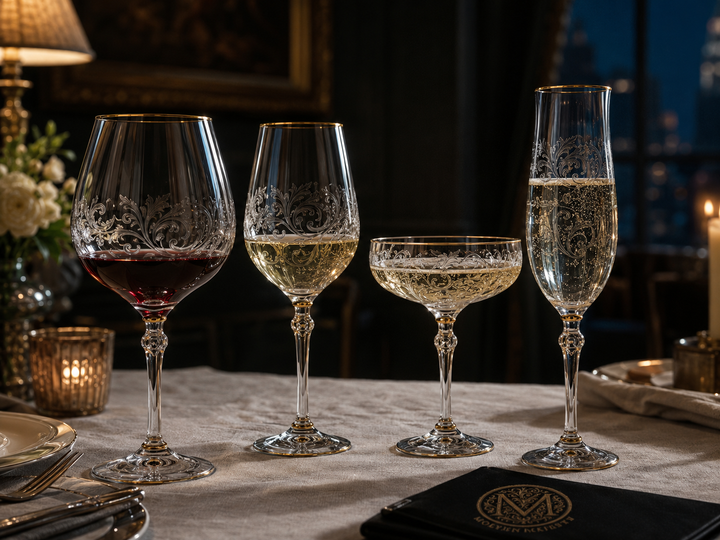
The Platora Coupe Glass and Platora Champagne Flute make the comparison unusually direct. Both are currently described by Molten Majesty as hand-blown and hand-cut in Istanbul, and both use a platinum rim. Their principal difference is the shape presented to the drink.
The coupe opens outward immediately. The flute carries the wine upward in a narrow column. On the same table, they can almost look like two opinions expressed in the same handwriting.
What is a champagne coupe?
A coupe is a stemmed glass with a broad, shallow bowl and a wide opening.
Its proportions give sparkling wine a large exposed surface. That makes the wine immediately accessible to the nose and mouth, but it also gives dissolved carbon dioxide an easier route into the surrounding air. The Comité Champagne specifically notes that a coupe allows bubbles and aromas to escape quickly because of its wide opening.
The coupe remains useful because wine performance is only one part of glass selection.
Its broad bowl gives it a strong visual presence on a dining table, and the open form works naturally for cocktails served without ice. The Platora Coupe product page also positions the form for Champagne and cocktails, which is a sensible dual purpose for the silhouette.
A coupe is especially comfortable at a seated dinner, where the glass can remain on the table between sips. It asks for a little more attention when carried through a crowded room. The rim is wide, and gravity has never shown much respect for a dress code.
What is a champagne flute?
A Champagne flute is tall, narrow and usually tapered only slightly toward the rim.
The shape keeps the wine in a deeper column and reduces the exposed surface area relative to a coupe. In the Liger-Belair study, that geometry slowed the progressive loss of dissolved CO2.
The flute also gives rising bubbles a long vertical path. This makes effervescence visually prominent, which helps explain its enduring association with receptions and celebratory toasts.
Its practical virtues are easy to appreciate when twenty people are standing rather than six people sitting. A narrow opening offers more protection from sudden movement, and the glass occupies relatively little horizontal space on a tray.
There is a trade-off. The Comité Champagne says a traditional flute can be too narrow for aromas to develop fully. The official recommendation for tasting is a taller tulip shape with a broader lower bowl and a tapered opening.
Does a coupe make Champagne go flat faster?
Yes, compared with a flute under similar conditions.
The broad bowl exposes more wine to the air. Measurements of dissolved carbon dioxide found that Champagne lost CO2 significantly faster in a coupe than in a flute during the period following the pour.
“Flat faster” still deserves some proportion.
A coupe does not erase the bubbles the moment Champagne reaches the bowl. If the drink is poured and enjoyed promptly, it remains sparkling. The difference becomes more relevant when a glass sits untouched through a long conversation.
The person telling that conversation may, of course, consider this someone else's problem.
Does glass shape change aroma?
Yes. Glass shape changes the space above the wine and the way volatile compounds and carbon dioxide leave the surface.
The Comité Champagne describes the coupe as too open because aromas disperse rapidly, while the traditional flute can be too narrow for them to develop fully. Its preferred tulip shape widens around the wine and narrows again at the rim.
Research on Champagne also shows that glass shape affects CO2 release, which matters because rising and bursting bubbles participate in aroma transport. A PubMed-indexed study from researchers at the University of Reims found that glass shape and bubble conditions influence the mechanisms involved in aroma release and flavour perception.
This gives the three principal forms a useful hierarchy:
- Coupe: widest opening and fastest aromatic dispersion
- Flute: strongest protection for effervescence, with less room for aromas
- Tulip: broader aromatic chamber with a tapered opening
The tulip is the technical compromise. The coupe and flute remain compelling because dinner rarely takes place under laboratory conditions.
Which glass is better for different occasions?
| Occasion | Better choice | Why |
| Formal toast | Flute | Narrow, recognisable and practical while standing |
| Seated dinner | Coupe or tulip | More room for aroma and comfortable sipping |
| Large reception | Flute | Easier to carry and arrange closely on trays |
| Champagne cocktail | Coupe | Broad bowl suits many drinks served without ice |
| Prosecco or other sparkling wine | Either | Choose according to bubble retention or presentation |
| Vintage or aromatic sparkling wine | Tulip | Gives the wine more aromatic space while retaining a tapered rim |
| Tablescaping | Coupe | Broad horizontal form creates a distinct visual rhythm |
A wedding reception with two hundred moving guests asks different things of a glass than a bottle opened between four people at dinner.
The table gets a vote.
Coupe vs flute vs tulip glass
The tulip deserves a place in the comparison because neither the coupe nor flute is the Comité Champagne's preferred tasting shape.
A tulip glass is tall enough to support a column of sparkling wine, broader around the lower bowl than a flute, then narrower at the rim. According to the Comité Champagne, this gives the bubbles room to develop while concentrating aromas above the wine.
Choose a tulip when the wine itself is the main event, particularly for mature, vintage or aromatically complex sparkling wines.
Choose a flute when the occasion values prolonged effervescence, a formal silhouette and easy handling.
Choose a coupe when presentation, cocktails and an open drinking experience matter more than keeping every bubble for as long as possible.
There is no requirement for one glass to win every evening.
How should you pour a coupe or flute?
Pour sparkling wine slowly and leave enough room above the wine for movement and aroma.
The Comité Champagne recommends pouring Champagne in two stages and filling the glass to roughly two-thirds. It also estimates that a standard 750 ml bottle serves around six 125 ml flute pours, though actual service naturally depends on glass capacity.
With a coupe, visual fullness is deceptive. Its broad bowl can look underfilled with a perfectly sensible serving. Resist the temptation to bring the wine close to the rim. That gives the drink very little protection when the glass is lifted.
For tray service, flutes are easier to position closely. Coupes need more horizontal space between rims.
Hold either glass by the stem when practical. This keeps the hand away from the chilled bowl and leaves the glass clearer.
For the broader question of stemmed handling, see Stemless vs Stemmed Wine Glasses.
Which Molten Majesty glass should you choose?
Choose the Platora Champagne Flute when the evening centres on toasts, receptions or a traditional Champagne service. Its tall bowl gives sparkling wine a narrow path upward, while the platinum rim gives the silhouette a clear finish. Molten Majesty currently describes the piece as hand-blown and hand-cut in its Istanbul atelier.
Choose the Platora Coupe Glass when you want one glass to move between sparkling wine and cocktails or when a broad, shallow profile suits the table better. It shares the Platora platinum rim and the same confirmed atelier production description.
For a dinner involving several types of drinks, How to Choose Glassware for Cocktails, Water and Wine covers how to keep the table composed without placing the entire cabinet at every setting.
Both Platora glasses are currently listed with hand-wash care instructions. For the full method, see How to Clean Crystal Glassware.
Frequently asked questions
Does a coupe make Champagne go flat faster?
Yes. Research comparing the two forms found that dissolved CO2 was lost significantly faster from a coupe than from a flute. The broader exposed wine surface is the principal reason.
Can you drink Prosecco from a coupe?
Yes. A coupe can serve Prosecco or another sparkling wine perfectly well. Expect the bubbles to dissipate faster than they would in a narrower glass, and pour an amount you expect to drink reasonably soon.
Can a coupe be used for cocktails?
Yes. The broad bowl suits many cocktails served without ice, and the Platora Coupe itself is designed for use with Champagne or crafted cocktails.
Is a flute or coupe easier to hold at a reception?
A flute is usually more practical when guests are standing or moving. Its narrow opening offers more protection from spills, and the smaller horizontal footprint makes tray service easier. The exact stability still depends on the foot, stem and proportions of the individual glass.
What is the difference between a coupe and a tulip glass?
A coupe is shallow and broad with a wide rim. A tulip is taller, fuller around the lower bowl and tapered toward the opening. The Comité Champagne recommends the tulip form because it gives bubbles room to develop while concentrating aromas.
How full should a Champagne glass be?
The Comité Champagne recommends filling a glass to roughly two-thirds, poured slowly in two stages. With a coupe, keep the wine comfortably below the broad rim so the glass remains easy to lift and carry.
A flute protects the bubbles. A coupe opens the wine and changes the mood of the table. A tulip gives the wine the most balanced technical setting.
The best glass is the one whose compromise suits the bottle and the evening.