Hot Christmas drinks need heat-rated mugs or glasses, while chilled festive cocktails call for a very different collection of vessels. Mulled wine belongs in a suitable handled mug, eggnog works well in a small cordial goblet or punch cup, Champagne suits a flute or tulip, and a winter Old Fashioned needs a short tumbler. The right choice depends on temperature first, followed by serving size, ingredients and how the guest will hold the drink.
Christmas is one of the few occasions when a single drinks menu might involve steaming wine, chilled cream, sparkling cocktails and a generous red served with dinner. Choosing the glass becomes rather more interesting when some of those drinks can damage the wrong vessel.
Christmas drinks at a glance
-
Mulled wine and hot toddies: Use a vessel specifically approved for hot drinks, such as a heat-rated handled glass mug or a suitable ceramic mug.
-
Eggnog: A modest 4 to 6 US fl oz (118 to 177 mL) serving suits a small punch cup, cordial goblet or rocks glass.
-
Champagne: A flute helps retain bubbles, a coupe works beautifully for cocktails, and a tulip offers additional room for aroma.
-
Hot glassware: Thermal shock results from uneven temperature changes. Thick walls and decorative cutting do not guarantee heat resistance.
-
Punch service: Use small cups for cold punch, with a serving bowl confirmed suitable for the ingredients.
-
Serving sizes: The recommended quantity of a drink is often considerably smaller than the full capacity of its glass.
The Christmas drink chart: 20 drinks and the right glass for each
The following reference covers traditional Christmas drinks, seasonal cocktails and the wines commonly served during festive dinners.
The quantities are suggested serving ranges in US fluid ounces and millilitres. They are not fixed recipes or the total capacity of the glass. Leave additional room for ice, garnish, foam and comfortable handling.
| Christmas drink | Suggested serving | Best glass or vessel | Common alternative or mistake |
|---|---|---|---|
| Mulled wine (hot) | 6–8 oz / 177–237 mL | Heat-rated handled glass mug or ceramic mug | Ordinary wine glass without a heat rating |
| Hot toddy (hot) | 5–7 oz / 148–207 mL | Heat-rated toddy glass or handled mug | Rocks glass intended for cold spirits |
| Irish coffee (hot) | 5–7 oz / 148–207 mL | Heat-rated footed Irish coffee glass | Ordinary stemmed wine glass |
| Hot buttered rum (hot) | 6–8 oz / 177–237 mL | Heat-rated handled mug | Regular tumbler without hot-drink approval |
| Mulled or spiced cider (hot) | 6–8 oz / 177–237 mL | Heat-rated glass mug or ceramic mug | Cold-drink highball |
| Wassail (hot) | 6–8 oz / 177–237 mL | Heat-rated punch cup or handled mug | Decorative goblet without a heat rating |
| Tom and Jerry (hot) | 5–7 oz / 148–207 mL | Heat-rated Tom and Jerry mug or toddy glass | Ordinary decorative punch cup |
| Eggnog (usually chilled) | 4–6 oz / 118–177 mL | Small punch cup, cordial goblet or rocks glass | Oversized wine glass filled nearly to the rim |
| Champagne for a toast (chilled) | 4–5 oz / 118–148 mL | Champagne flute or tulip | Coupe when preserving bubbles is the priority |
| Champagne cocktail or Kir Royale (chilled) | 4–6 oz / 118–177 mL | Flute or coupe | Overfilled broad-rimmed glass |
| Mimosa (chilled) | 5–6 oz / 148–177 mL | Flute or small tulip | Large juice glass when presentation matters |
| Christmas punch (cold) | 4–6 oz / 118–177 mL | Punch cup or small goblet | Large highball for a small ladled serving |
| Cranberry Cosmopolitan (chilled) | 4–5 oz / 118–148 mL | Coupe or Nick & Nora | Very wide Martini glass carried while full |
| Espresso or peppermint Martini (chilled) | 3–5 oz / 89–148 mL | Coupe or cocktail glass | Rocks glass when the drink is strained and served up |
| Winter Old Fashioned (over ice) | 2–3 oz / 59–89 mL, before ice | Rocks glass or tumbler | Tall highball |
| Whisky neat | 1.5–2 oz / 44–59 mL | Rocks glass or whisky-tasting glass | Large snifter filled generously |
| Port, sherry or dessert wine | 2–3 oz / 59–89 mL | Small fortified-wine glass or cordial goblet | Large wine glass filled as for table wine |
| Red wine with dinner | 5–6 oz / 148–177 mL | Red wine glass or universal wine goblet | Water goblet selected without considering bowl shape |
| Christmas sangria (cold) | 6–10 oz / 177–296 mL | Large goblet or highball | Small rocks glass without room for fruit and ice |
| Peppermint hot chocolate (hot) | 6–8 oz / 177–237 mL | Heat-rated handled mug | Ordinary fine glass tumbler |
Hot-drink vessels must be approved by their manufacturer for the intended temperatures. Handles, stems and substantial bases do not establish heat resistance.
For an illustrated explanation of glass silhouettes and their full capacities, see Every Type of Drinking Glass, and What Each One Is Actually For.
Mulled wine: mug or wine glass?
A heat-rated handled mug is the safer choice for hot mulled wine.
The familiar red-wine glass may look attractive with a cinnamon stick and orange slice resting against its bowl, but appearance gives no indication of thermal resistance. Ordinary drinking glasses can crack when exposed to sudden temperature changes, even when their walls appear substantial.
Mulled wine is usually heated gently and served warm. Its vessel needs to tolerate both the serving temperature and the transition from room temperature to that temperature.
A ceramic mug works perfectly well. It offers a handle and keeps the guest's fingers away from the warm body of the vessel.
For a transparent presentation, choose a glass mug expressly designed for hot beverages. Footed Irish-coffee-style glasses are also an option when their manufacturer confirms suitable heat resistance.
Does mulled wine need a tempered glass?
The vessel needs a confirmed rating for hot service.
Tempered glass, properly designed borosilicate drinkware and other heat-rated materials can be appropriate, depending on their individual construction and manufacturer instructions.
SCHOTT's explanation of heat-resistant glass describes why borosilicate performs well under changing temperatures. Its comparatively low thermal expansion makes it suitable for applications that demand greater resistance to thermal shock.
Ordinary fine crystal does not automatically share those properties.
That distinction matters for decorative cut glass. The weight of a thick base can inspire confidence, but weight alone provides little useful information about whether the vessel can withstand a hot pour.
Molten Majesty's current cut, engraved and metallic-rimmed drinkware has no confirmed general approval for hot-beverage service. Use appropriate heat-rated vessels for mulled wine.
Hot toddy vs Irish coffee glass: what is the difference?
Both drinks can be served in suitable heat-rated toddy glasses, although Irish coffee traditionally benefits from a taller vessel.
A hot toddy usually combines a spirit with hot water and ingredients such as honey and citrus, depending on the recipe. It is often served in a handled glass or mug that can be held comfortably while the drink remains warm.
Irish coffee combines hot coffee, whiskey and cream. Its presentation benefits from additional height because the cream traditionally rests above the coffee.
Difford's Guide describes the toddy glass as a vessel associated with hot cocktails and Irish coffee. Such glasses may have a stem or handle, and their construction must be appropriate for hot drinks.
The main difference is therefore proportion and presentation.
A toddy is comfortable in a relatively compact handled vessel. Irish coffee benefits from a taller glass in which the coffee and cream can be seen separately.
Either drink can also be served in a suitable ceramic mug. It is a practical choice, especially when several guests are being served at once.
Eggnog: punch cup, cordial goblet or rocks glass?
All three are appropriate for chilled eggnog. The most useful distinction is serving size.
Eggnog is rich, whether prepared with spirits or without them. A modest serving of approximately 4 to 6 ounces (118 to 177 mL) is a sensible starting point.
The glass should leave a little room for nutmeg or another garnish. Nobody needs to discover the limits of a full eggnog glass while carrying it across a carpet.
A punch cup for traditional serving
A punch cup works well when eggnog is being ladled from a communal bowl.
Its smaller capacity encourages reasonable portions and makes serving straightforward. A handle, where present, can make the cup easier to carry during a standing gathering.
A cordial goblet for after-dinner eggnog
A small cordial goblet gives eggnog a more deliberate place at the table.
The stem raises the drink above the linen, while the smaller bowl suits a restrained serving. It is particularly attractive when eggnog is offered after dinner rather than as a large drink during the evening.
The Roccaré Cordial Goblet (Sunlit Amber) is a useful example.
Its coloured glass, hand-cut decoration and gold detailing give the small vessel a presence that larger, plainer glasses may lack. The faceted stem provides a clear place to hold the goblet, keeping fingers away from the bowl.
Roccaré is available in six colour variations, allowing a Christmas table to use a coordinated selection or individual colours.
For a chilled eggnog service, the Sunlit Amber and Crimson Red variations sit particularly comfortably among candlelight, evergreen branches and warm-toned table linens.
The goblets are designed for cordial-scale servings. They should not be treated as full-size wine glasses or used for hot eggnog without explicit manufacturer approval.
A rocks glass for informal serving
A short tumbler is the simplest alternative.
Its broad opening leaves room for garnish, and the base offers stability. A tumbler also moves comfortably between eggnog, whisky and shorter cocktails throughout the evening.
The Filigrae Tumbler is one example for chilled service.
Each option works. The decision depends on whether eggnog is arriving from a punch bowl, following dessert or being served while everyone is still gathered in the sitting room.
Champagne: flute or coupe for the Christmas toast?
A flute is particularly useful for standing toasts. A coupe works well for Champagne cocktails and seated celebrations.
The flute's tall, narrow bowl reduces the exposed surface of the wine compared with a broad coupe. This helps slow the loss of dissolved carbon dioxide.
The coupe gives sparkling wine a wider opening and a more theatrical presentation, although bubbles escape faster.
For Champagne tasting, the Comité Champagne recommends a tulip-shaped glass, whose broader middle provides space for aroma while the narrowed rim helps retain it.
At a large Christmas reception, flutes are practical because they take up less space on serving trays and are more forgiving when guests are standing.
At a seated dinner, a tulip or coupe may suit the occasion better.
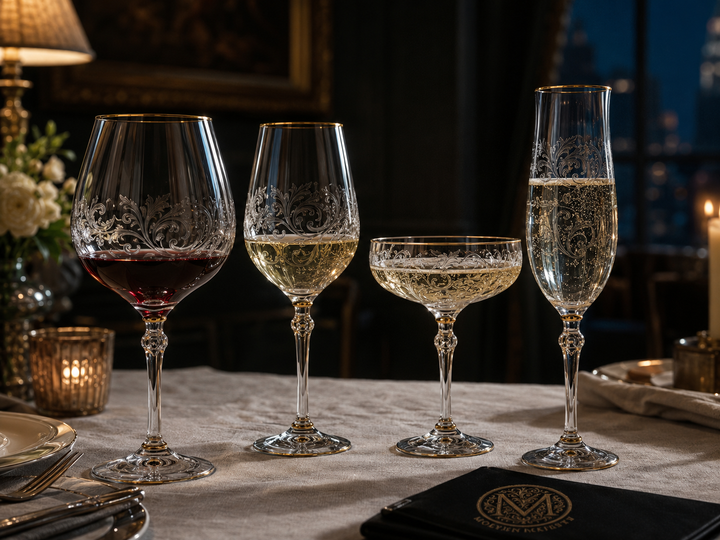
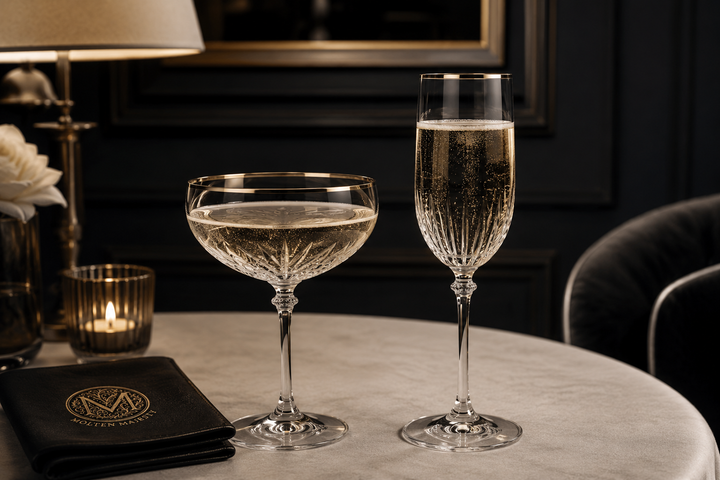
The Platora Champagne Flute represents the traditional tall silhouette, while the Platora Coupe Glass offers the broad, shallow form associated with sparkling cocktails.
Both can belong at Christmas, though they need not appear on the table simultaneously.
For the full comparison, see Champagne Coupe vs Flute: Which Glass Is Better?.
Christmas punch: a communal bowl or individual glasses?
A punch bowl with small cups is useful when a cold drink has been prepared in advance for a group.
Guests can serve themselves, and the cups encourage modest portions. A typical cold-punch serving might be approximately 4 to 6 ounces (118 to 177 mL), depending on the ingredients and strength.
The bowl should have enough room for a ladle, while its base must remain stable as the contents are served.
Can a decorative crystal bowl hold Christmas punch?
Only when its exact material and intended-use instructions permit it.
Cold punch may contain wine, spirits, citrus juice or other acidic ingredients. A bowl approved for dry food or floral arrangements is not automatically approved for storing those liquids.
Molten Majesty's Verdura Collection provides an example of broad pedestal forms and substantial cut-to-clear decoration. Their geometry resembles the formal serving bowls traditionally associated with festive tables.
However, decorative suitability is a separate question from food-contact approval. Confirm that a particular bowl is approved for the ingredients and duration of service before using it as a punch bowl.
Hot punch needs a heat-rated vessel. Ordinary decorative crystal bowls should not be used for hot beverages without express manufacturer approval.
What if you are serving only a few guests?
A suitable pitcher and small glasses can be more practical than a punch bowl.
For cold punch, choose a pitcher that accommodates the fruit and other ingredients, then serve in water goblets or tumblers of appropriate capacity.
A Roccaré Cordial Goblet can be an attractive option for smaller chilled servings, while larger mixed drinks are better suited to a highball or generous goblet.
The glass should match the drink's volume. A vessel chosen purely for its decoration can become inconvenient once ice, fruit and a ladle are involved.
Port, sherry and dessert wine: why is the glass so small?
Small glasses suit many fortified and dessert wines because the serving itself is usually modest.
Port and certain styles of sherry have higher alcohol concentrations than ordinary table wine, while dessert wines can be concentrated in flavour and sweetness.
A typical home-serving range of approximately 2 to 3 ounces (59 to 89 mL) works for many such drinks, adjusted to the particular wine.
A small stemmed glass leaves room above the pour for aroma without asking the guest to manage a large volume.
Why cordial goblets work
A cordial goblet has a smaller bowl and a shorter serving capacity than most contemporary wine glasses.
The form is associated with liqueurs and other small after-dinner drinks. It can also be useful for certain fortified wines, provided the opening allows the wine to be smelled comfortably.
This is where the Roccaré Collection has a particularly natural role.
Roccaré cordial goblets use coloured glass with decorative cutting, gold accents and a faceted stem. The collection includes Sunlit Amber, Sylvan Emerald, Regal Violet, Orchid Rosé, Midnight Sapphire and Crimson Red.
The Roccaré Cordial Goblet (Regal Violet) offers a deeper colour for a winter evening, while Sunlit Amber brings a warmer tone.
Individual Roccaré cordial goblets are currently listed from $34.99, with selectable piece quantities on the product pages.
The small bowl is intentional. A cordial glass is not a miniature wine glass that somehow failed to grow.
For complex aged port or sherry, a conventional fortified-wine tasting glass may provide a better aromatic opening. Choose the vessel according to the wine rather than the name alone.
Which glasses belong to cold Christmas cocktails?
Cold Christmas cocktails tend to fall into a few familiar serving families.
A cranberry Cosmopolitan is usually strained and served without ice. A coupe or Nick & Nora suits that style.
An espresso Martini also works in a coupe or cocktail glass, leaving a broad surface for foam.
A winter Old Fashioned belongs in a short tumbler. Its lower bowl accommodates a large piece of ice while keeping the drink compact.
Christmas sangria needs considerably more room. Fruit, ice and the drink itself all occupy space, so a highball or larger goblet is appropriate.
Where Ascend fits into Christmas entertaining
The Ascend Collection offers several forms that work together for a cold-drink service.
Its Highball Glass suits tall mixed drinks, soda-based cocktails and cold non-alcoholic refreshments.
The Ascend Stemless Wine Glass works for wine, chilled water and certain spritz-style drinks, depending on the serving and ingredients.
The collection also includes Sauvignon and Bordeaux wine glasses, which bring different bowl proportions to the dinner table.
The designs share fine vertical cutting and restrained gold detailing, allowing different drinks to be served in appropriately shaped vessels without introducing an unrelated pattern at every place setting.
For a Christmas dinner, the Ascend Bordeaux Wine Glass is an appropriate choice for red wine, while the Ascend Sauvignon Wine Glass suits many chilled whites.
These pieces are intended for their documented beverage uses. Their decorative finish does not establish suitability for hot drinks.
From the atelier: why hot drinks can crack glass
Glass expands when heated and contracts when cooled.
When a hot drink reaches the inside of a cooler vessel, the inner surface begins changing temperature before the outer wall does. That difference in expansion can produce stress within the glass.
If the stress becomes greater than the material can withstand, the glass may crack.
This process is called thermal shock.
The risk depends on several factors: the composition of the glass, its thickness, its shape, existing surface damage and the speed and magnitude of the temperature change.
Why thick crystal is not necessarily safer
A thick-walled object may develop a greater temperature difference between its inner and outer surfaces during rapid heating.
Deep cutting can introduce changes in wall thickness and surface geometry. Those changes should be considered when evaluating thermal stress, although cutting alone does not determine whether a particular piece will crack.
The material specification remains the deciding factor.
SCHOTT's guidance on heat-resistant glass explains why borosilicate compositions can tolerate temperature changes particularly well.
Their lower thermal expansion helps reduce the stress created by uneven heating.
Ordinary decorative crystal should not be assumed to behave the same way.
How can you tell whether a glass is safe for hot drinks?
Read the manufacturer's instructions.
Look for explicit statements covering hot beverages or a specified temperature range. A handle, a thick base or a heavy construction does not establish thermal suitability.
Some heat-rated vessels benefit from gentle prewarming according to the manufacturer's instructions. Prewarming can reduce the initial temperature difference, but it cannot make an unsuitable vessel heatproof.
The familiar metal-spoon trick is sometimes used to reduce thermal shock when pouring hot liquid. It is not a substitute for selecting glassware designed for hot drinks.
Molten Majesty's hand-cut, engraved and metallic-rimmed pieces referenced in this article have no confirmed general hot-drink approval.
Keep them within their documented uses. An evening's hospitality should not become an experiment in materials science.
For everyday care, see How to Clean Crystal Glassware Without Clouding or Scratches.
What type of glass is best for serving mulled wine?
A heat-rated handled glass mug is an appropriate choice for mulled wine. A ceramic mug is also practical.
The vessel must be suitable for hot beverages. Ordinary wine glasses and decorative cut crystal should not be used unless the manufacturer expressly confirms their heat resistance.
What are some good glass cups for mulled wine?
Purpose-made hot-drink glasses, suitable borosilicate mugs and heat-rated Irish-coffee-style vessels are good options.
Choose a comfortable handle or safe gripping area, adequate capacity and a confirmed hot-beverage rating. Appearance alone cannot establish that the material will tolerate the drink.
How should you serve eggnog?
Serve chilled eggnog in a small punch cup, cordial goblet or short tumbler.
A 4 to 6-ounce (118 to 177 mL) serving is a useful starting point, with space for nutmeg or another garnish. A Roccaré cordial goblet suits a restrained chilled serving, subject to its actual capacity.
If the eggnog recipe is served hot, use a heat-rated mug or glass.
What are you supposed to drink with eggnog?
Eggnog can be enjoyed without alcohol or prepared with spirits such as rum, bourbon or brandy.
At a Christmas gathering, offer water and a non-alcoholic option alongside any alcoholic version. Its richness makes small servings especially practical.
What are some good glasses for hot beverages?
Choose glassware expressly rated for hot drinks, including suitable borosilicate mugs and purpose-made toddy or Irish coffee glasses.
Ceramic mugs are another practical choice. Do not assume that fine crystal, coloured goblets or ordinary tumblers can tolerate hot liquid simply because they look substantial.
What kind of glass do you serve sparkling wine in?
A tulip-shaped glass provides a useful balance of aromatic space and bubble presentation.
A flute is practical for toasts and receptions, while a coupe suits sparkling cocktails and occasions where presentation matters more than prolonged effervescence.
What is the most popular drink during Christmas?
There is no single Christmas drink that is most popular in every country or household.
Mulled wine is closely associated with European winter traditions, while eggnog is familiar in North American celebrations. Champagne, other sparkling wines and seasonal punches are also common choices.
The right drinks menu depends on the guests and the occasion.
What to drink at a Christmas party?
Offer a manageable selection covering different preferences.
A sparkling drink, a cold cocktail or punch, a non-alcoholic alternative and a suitable hot beverage will cover many gatherings.
Prepare the appropriate vessels in advance and keep hot-drink service separate from ordinary fine glassware.
Guests should have more interesting decisions to make than whether their glass can withstand the drink.
From the house: glassware for Christmas entertaining
Christmas entertaining benefits from having several shapes available. The most useful collection is one that moves naturally between water, wine, cocktails and smaller after-dinner servings.
Molten Majesty offers several complementary forms for cold drinks. None of the following pieces should be treated as an approved substitute for heat-rated mugs.
Altiera 18 Piece Luxury Collection | $454.99
Explore the Altiera 18 Piece Luxury Collection.
This collection contains six goblets, six highballs and six tumblers.
The three silhouettes cover much of the cold-drink service described in this guide. Goblets suit water and table service, highballs provide space for long mixed drinks, and tumblers accommodate whisky and shorter cocktails.
The repeated fluted cutting ties the forms together without making them identical.
For a household that regularly entertains, Altiera offers a practical foundation.
Roccaré Cordial Goblets | From $34.99 per glass
Explore the Roccaré Collection.
Roccaré fills a different place at the table.
Its smaller cordial goblets are intended for modest servings, making them suitable for chilled eggnog, selected liqueurs and certain small after-dinner drinks.
The collection's six colours also make it possible to bring a deliberate palette to the service without changing the underlying glass form.
A Sunlit Amber goblet beside a winter dessert creates a different effect from a Sylvan Emerald one, particularly under candlelight. The vessel remains the same type; the colour changes how the table reads.
Roccaré is especially useful when the host already has ordinary wine glasses and tumblers but wants a smaller, more decorative serving form.
The goblets are hand-wash pieces and are not confirmed for hot beverages.
Ascend Collection | Individual pieces from $24.99
Explore the Ascend Collection.
Ascend offers a coordinated approach to Christmas wine and mixed-drink service.
The collection includes the Ascend Highball Glass, Stemless Wine Glass, Sauvignon Wine Glass, Bordeaux Wine Glass and Decanter.
The Highball and Stemless Wine Glass are listed at $24.99 each for their single-piece options, while the Sauvignon and Bordeaux Wine Glasses are listed at $29.99 each.
The forms have distinct purposes. A Bordeaux bowl gives a red wine more room, the Sauvignon shape suits chilled whites, and the highball accommodates a long drink with ice.
Fine vertical cuts and gold-rim detailing establish a relationship across the collection without asking every guest to use the same glass.
Ascend is the strongest choice of the three for someone looking to build a consistent wine service while retaining options for everyday cold drinks.
Prices are publicly listed USD starting prices checked in October 2026 and may change. Selectable quantities can affect the final price. Always follow each product's specific care and intended-use instructions.
For further guidance on choosing drinking glasses as gifts, see Crystal Anniversary Gifts: What to Give for a 15th Anniversary.
A successful Christmas drinks service is prepared around the beverages guests will actually enjoy.
Champagne needs room for its bubbles. A small glass of eggnog deserves a sensible portion. A long cocktail needs space for ice.
And hot mulled wine deserves a vessel made for the temperature, even if the crystal cabinet objects to being left out of the festivities.