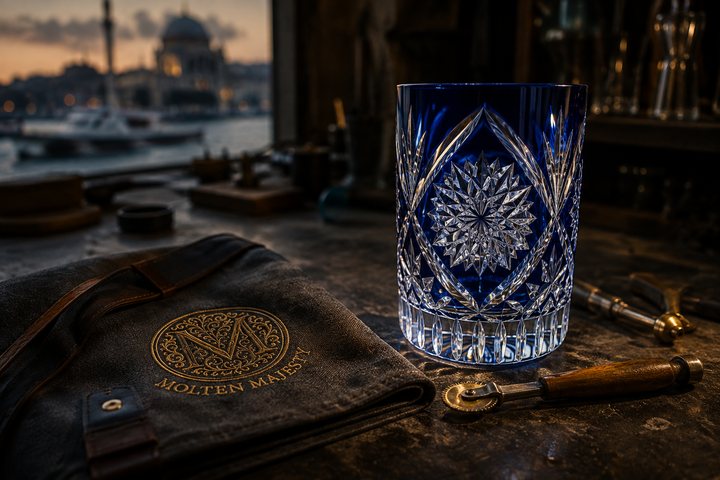
Two glasses can share the same silhouette and perform the same task. Their making, however, leaves a different kind of presence behind.
Handblown glass is shaped while hot by a glassworker using breath, gravity, tools and, in some cases, a mould. Machine-made glass is formed through automated pressing or blowing processes designed to reproduce the same dimensions at scale. The clearest differences are usually found in consistency, wall thickness, balance, finishing and the degree of variation between pieces. Neither method guarantees quality on its own. The better choice depends on whether exact repetition or evidence of individual making matters more to you.
What does “handblown glass” actually mean?
Handblown glass begins with molten glass gathered onto the end of a blowpipe. Air creates the first hollow form. From there, the glassworker develops the shape through movement, reheating and the use of tools.
The phrase is broader than many shoppers assume. A handblown object does not have to be shaped entirely without a mould. The Corning Museum of Glass defines free-blown glass as glassware shaped solely through inflation and manipulation with tools. Mould-blown glass, by comparison, is inflated inside a mould so that the hot glass takes on its internal shape. Both can involve a glassworker and a blowpipe.
This distinction matters because a mould is not evidence of machine production by itself.
An artisan may use one to establish a repeating profile, create ribs or control the dimensions of a vessel. The work may then continue by hand as the rim is opened, the foot is attached or the final proportions are corrected. The mould provides a boundary. It does not necessarily make every decision.
How is machine-made glassware produced?
Machine production replaces much of the direct shaping process with automated, repeatable movement.
Molten glass is portioned and formed in moulds through pressing, blowing or a combination of the two. Glass Alliance Europe notes that most industrial glass containers and tableware are made through pressing and blowing molten glass in moulds. The process allows manufacturers to produce large quantities with closely controlled dimensions.
This precision is one of machine production’s genuine strengths.
A restaurant replacing a broken glass six months later may want the new piece to match the rest of the service as closely as possible. A hotel ordering several hundred tumblers needs predictable capacity, height and stackability. For these purposes, variation is a complication rather than a virtue.
Machine-made glassware can also be thin, clear and beautifully proportioned. Production method should never be used as a substitute for examining the finished object.
Handblown vs machine-made glassware at a glance
| Consideration | Handblown glassware | Machine-made glassware |
|---|---|---|
| Forming method | Shaped by a glassworker with a blowpipe and tools, sometimes with a mould | Formed through automated pressing or blowing in moulds |
| Consistency | Small differences may appear between pieces | Dimensions are closely repeated |
| Surface evidence | May retain tool marks or traces of the pontil | May show mould seams, although these can be removed |
| Weight and thickness | Can vary slightly according to the maker and form | Usually controlled to a fixed specification |
| Replacement pieces | A later piece may not match perfectly | Matching replacements are generally easier to produce |
| Production scale | Made in smaller quantities | Suited to high-volume production |
| Price | Labour and hand finishing often increase the cost | Scale usually reduces the cost per piece |
| Best suited to | Buyers who appreciate individual character and artisanal work | Buyers who prioritise uniformity, practicality and easy replacement |
Can you see the difference?
Sometimes. The signs are rarely as decisive as online identification guides make them sound.
A pontil mark is often presented as proof that a piece was handblown. The pontil, also called a punty, is a metal rod attached to the base so the glassworker can hold the vessel while finishing its open end. When removed, it can leave an irregular or ring-shaped scar.
That mark is useful evidence, but its absence proves very little. A pontil scar may be ground and polished until it becomes difficult to see. Other holding tools can avoid the traditional mark altogether.
A narrow ridge running along the body may indicate that the object was made in a multipart mould. The Corning Museum of Glass describes this as a seam mark, formed where molten glass enters the joins between sections of the mould. On well-finished glassware, the seam may be reduced through grinding or fire polishing.
Here again, the conclusion is not automatic. A handblown vessel may have entered a mould, while a carefully finished machine-made glass may show no obvious seam.
The most reliable approach is to study several pieces together.
Place two glasses from the same set side by side. Look at the height of the rims, the width of the bowls and the thickness of the bases. Turn them slowly in the light. Handmade pieces may reveal small differences that are difficult to detect when each is viewed alone.
Does handblown glass feel different in the hand?
It can, although the sensation depends as much on the design as the production method.
A glass may feel refined because its rim is thin, its weight is properly distributed and its bowl sits comfortably above the stem. None of these qualities belongs exclusively to handmade production. A skilled artisan can make a poorly balanced glass. A well-engineered machine can produce an excellent one.
The difference is often found in how the form was resolved.
During hand production, the maker can respond to the glass as it moves. A bowl that has become slightly heavy may be opened differently. The stem may be adjusted to suit the weight above it. Small decisions remain available until the material cools beyond the point at which it can be shaped.
Machine production follows established tolerances. Its achievement is repeatability. Hand production allows a more immediate conversation with the material.
That conversation is only valuable when the maker has something worthwhile to say.
Are bubbles and irregularities signs of handmade glass?
They can be consequences of the making process, but they should not be treated as certificates of authenticity.
A small bubble does not automatically make an object handblown. Nor does perfect clarity prove that it was produced by a machine. The composition of the glass, the condition of the melt and the standard of production all affect the finished surface.
The same caution applies to irregularity.
Slight differences in proportion, cut depth or surface character may belong naturally to handmade work. A sharp rim, unstable foot, crack or badly distorted form is a defect. Calling every flaw a mark of craftsmanship lowers the standard rather than defending it.
Handmade variation deserves appreciation when the object remains deliberate.
From the atelier: variation must still feel resolved
When examining a finished piece, the first question should not be whether it is identical to its neighbour.
Look instead at whether it sits securely. Feel how the weight moves through the hand. Check that the rim is smooth and properly finished. On a stemmed glass, consider whether the bowl feels balanced above the stem. On cut glass, examine whether the decoration follows the architecture of the vessel rather than fighting against it.
This is where workmanship becomes visible.
Two handmade pieces may differ by a few millimetres and still belong convincingly to the same set. Their proportions speak the same language. The variations do not distract from the design.
A careless object feels accidental. A handmade object should feel considered.
Is handblown glass more fragile?
Handblown does not automatically mean fragile, and machine-made does not automatically mean durable.
Strength depends on the glass composition, wall thickness, shape, finishing and cooling process. Both handmade and machine-made objects must be annealed, which means cooling them gradually to reduce internal strain. If hot glass cools too quickly, it may become vulnerable to mechanical or thermal shock.
A very thin handblown wine glass may require more care than a thick machine-made tumbler. A substantial handmade bowl may be considerably more robust than either.
Decoration also affects care. Deep cutting creates edges and recesses that should be handled thoughtfully. Gold- or platinum-rimmed glassware should generally be washed by hand unless the maker specifically states otherwise. The method used to form the vessel is only one part of the object’s practical life.
Which type of glassware should you choose?
Choose handblown glassware when the making of the object is part of what you value.
It suits a table where subtle variation feels welcome, a gift chosen for its individuality or a collection intended to be lived with over time. The appeal lies in the relationship between design and execution. You can see where control was exercised and where the material was allowed a small degree of freedom.
Choose machine-made glassware when uniformity has a practical purpose. It is often the sensible choice for large services, daily use, commercial settings or households where straightforward replacement matters.
Many homes have room for both.
Machine-made tumblers may serve breakfast every morning. Handcrafted goblets may appear at dinner, not because the occasion demands ceremony, but because someone has decided that beautiful objects should be used.
The meaningful difference is not whether a hand or machine touched the glass. It is whether the finished piece gives you a reason to notice it.
Suggested Molten Majesty connection
For glassware shaped and finished with an emphasis on individual character, explore Molten Majesty’s handcrafted collections. Each design is intended to retain the clarity of its form while allowing the work of the maker to remain quietly visible.
Care note
Wash delicate, hand-cut or metallic-rimmed glassware separately by hand using lukewarm water, a soft cloth and a mild detergent. Avoid sudden temperature changes, abrasive pads and pressure against the rim.