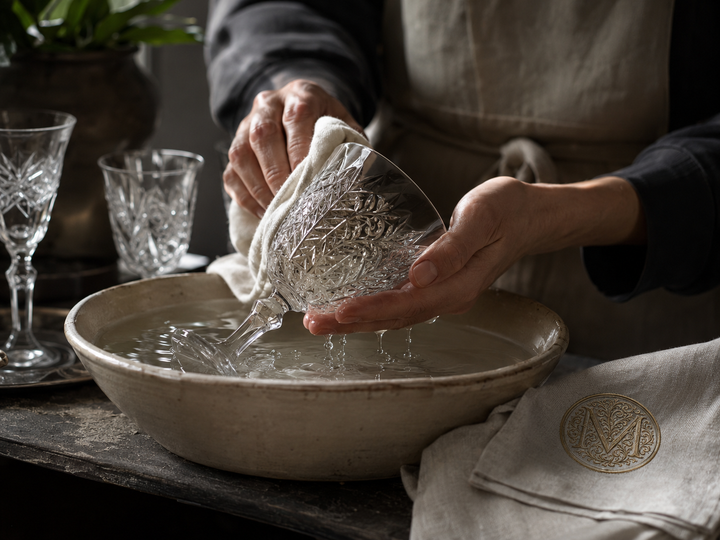
The safest cabinet is not necessarily the emptiest one. It is the one in which every piece has somewhere secure to rest.
Most delicate crystal glasses should be stored upright on their bases, completely dry and far enough apart that their rims and bowls cannot touch. Decorative bowls, vases and decanters should also rest on their intended bases rather than against a narrow rim or ornamental edge. Avoid stacking unless the pieces were designed for it. For long-term storage, choose a stable, enclosed cabinet away from heat, direct sunlight and abrupt temperature changes. Waterford specifically recommends upright storage to protect fine crystal rims.
Should crystal glasses be stored upright or upside down?
Delicate crystal glasses are generally safest when stored upright.
The base was designed to carry the weight of the glass. The rim was designed for drinking. When a glass is turned upside down on a shelf, its weight rests on the thinnest and often most exposed part of the vessel. A perfectly smooth shelf may appear harmless, but repeatedly placing a fine rim against a hard surface creates opportunities for small chips and abrasions.
Waterford advises storing and drying fine crystal upright to preserve the rim. Riedel similarly warns against drying glasses upside down on a metal rack because the contact can damage the edge.
Upright storage does allow some dust to settle inside the bowl. That is usually the easier problem to solve. A light rinse or careful polish before use is preferable to placing lasting pressure on a delicate rim.
For sturdy everyday tumblers, upside-down storage may be less concerning if the manufacturer permits it and the supporting surface is clean and soft. The finer, older or more intricately finished the glass, the stronger the case for storing it upright.
How much space should be left between glasses?
Each glass should have enough room to be lifted without knocking the pieces beside it.
The danger is rarely that glassware simply stands close together. Damage occurs when one glass is pulled forward and its bowl, rim or foot catches another. Cut crystal adds another point of contact because pronounced facets and edges can meet the smooth surface of a neighbouring piece.
There is no useful universal measurement because a broad Burgundy bowl and a narrow flute occupy space differently. A practical test is to reach for each glass using the same movement you would make while setting the table. If another piece moves, rings or needs to be held out of the way, the arrangement is too tight.
The Canadian Conservation Institute recommends organising storage to reduce unnecessary handling and advises lifting glass objects with both hands rather than by vulnerable projections such as handles or spouts. The same principle belongs in a household cabinet: the arrangement should allow an object to leave the shelf without disturbing everything around it.
A cabinet that holds twelve glasses comfortably is safer than one forced to hold sixteen.
Is a hanging stemware rack safe?
A well-fitted hanging rack can be suitable for frequently used stemware, but it is not automatically the best choice for every glass.
A hanging rack does not support a glass on its rim. The foot slides into a track, leaving the bowl suspended below. That makes it different from placing a glass upside down directly on a shelf.
Before using one, inspect how the glass sits:
- The foot should rest securely inside the track.
- The stem should not be pinched or forced sideways.
- The bowls should not touch one another.
- The glass should slide in and out without scraping.
- The rack should be mounted where heads, cabinet doors and nearby objects cannot strike the suspended bowls.
Hanging storage works best for stemware used often enough that it does not remain exposed for long periods. For rare, delicate or irreplaceable pieces, an enclosed cabinet usually offers better protection from dust, accidental contact and movement around the room.
A rack may save space. It should not ask an unusually fine glass to adapt to hardware that was never designed for its proportions.
Can crystal bowls and decorative glass be stacked?
Decorative glass should not be stacked unless the design was specifically intended for stacking.
Two bowls may appear to nest neatly, yet the upper piece can concentrate its weight on a narrow ring inside the lower one. Cut surfaces can rub. A slight shift while removing the top bowl may scrape an engraved, coloured or gilded surface.
The Canadian Conservation Institute advises placing a soft cushioning material between glass or ceramic objects when stacking cannot be avoided.
For valuable or deeply cut bowls, individual storage is preferable. Give each piece its own footprint. A large decorative bowl may use more shelf space than its practical function appears to justify, but compressing several objects together transfers the inconvenience from the cabinet to the glass.
Where stacking is unavoidable, use a clean, soft, non-abrasive separator large enough to prevent glass-to-glass contact. Do not allow the upper object to rest on a painted, gilded or metallic edge. Check the arrangement periodically, particularly if the cabinet is opened and closed often.
How should heavy decorative bowls be positioned?
A heavy bowl should sit flat on its base, with no part of its body leaning against the cabinet wall or another object.
Weight does not make an object immune to damage. A substantial crystal bowl may be difficult to chip during ordinary use, yet its mass gives it greater force if it shifts, tips or meets another piece.
Place larger objects on shelves that can comfortably support them. Avoid high shelves if retrieving the bowl requires reaching above eye level or supporting it with one hand. The safest position is one from which the object can be lifted with both hands and brought directly toward the body.
Before placing a heavy piece inside the cabinet, check that the shelf is level and does not flex. The base should make stable contact with the surface. A bowl that rocks slightly should not be corrected by wedging hard material beneath one side. A soft, discreet support may be appropriate, but it should stabilise the base without pressing against the coloured overlay or cut decoration.
The cabinet should accommodate the object as it was made, rather than force it into the remaining space.
How should vases and decanters be stored?
Vases and decanters should be stored upright, empty and completely dry.
Moisture remaining in a narrow neck or deep body can leave visible deposits. Before placing a vessel away, allow enough time for its interior to dry rather than assuming that an apparently clear surface is ready for storage.
Stoppers deserve separate attention. A fitted crystal stopper can become difficult to remove if moisture or residue remains between the two surfaces. For long periods of storage, it may be safer to leave a stopper slightly separated from the neck or protect it beside the vessel, depending on the design and the maker’s care instructions.
Never lift a decanter by its neck, stopper or handle alone. The Canadian Conservation Institute advises using both hands and avoiding handles or spouts that may be less securely attached than the main body.
One hand should support the base. The other should steady the body.
Do gold and platinum rims need different storage?
Metallic-rimmed glassware needs the same physical protection as clear crystal, with additional care around the decorated edge.
Do not place a gold- or platinum-rimmed glass upside down on its rim. Even without visible chipping, repeated contact can abrade the applied finish. Leave enough room that metallic bands do not scrape neighbouring pieces when a glass is removed.
Make sure each piece is dry before it enters the cabinet. Avoid wrapping the decorated rim tightly in rough paper or fabric with prominent seams. The purpose of a cover or separator is to prevent contact, not create another surface that rubs against the finish.
Metallic decoration can make a cabinet arrangement look more formal, and that formality sometimes encourages owners to pack a complete set together with almost ceremonial precision. Resist the temptation. A few millimetres of visual disorder are preferable to a perfectly aligned row in which every rim touches the next.
Does cut or engraved glass require extra space?
Deeply cut glass benefits from slightly more breathing room than plain glassware.
A polished cut pattern is meant to meet light. Inside a crowded cabinet, the same raised geometry can meet another glass instead. The issue is not that a cut surface is inherently weak. It is that its edges create more possible points of contact.
Engraved areas should also remain free from rubbing, especially when the decoration is combined with colour or metallic detailing. Do not slide one piece behind another. Lift it clear of the shelf, then move it.
Riedel advises preventing glass from touching other glass or metal during washing because contact can create scratches. The same caution is sensible in storage, where repeated small movements can go unnoticed.
The clearer the separation between pieces, the easier it is to preserve both the glass and the pattern cut into it.
Where should a glassware cabinet be placed?
Choose a stable part of the home away from direct heat, intense sunlight and abrupt changes in temperature.
The Canadian Conservation Institute recommends keeping glass away from sources of heat or cold and avoiding fluctuating environmental conditions. It also advises limiting direct sunlight for sensitive collection objects.
In a domestic interior, that means avoiding cabinets immediately beside ovens, radiators or frequently opened exterior doors. A wall that receives strong afternoon sun may also be less suitable for coloured or decorated glass displayed behind clear cabinet doors.
The cabinet itself should close without shaking its contents. Shelves should sit level. Doors should not strike tall vessels, and drawers below should not cause the structure to vibrate every time they are opened.
Riedel also advises against keeping wine glasses beside strongly scented items because retained odours may interfere with the aroma of wine. A glassware cabinet is better used for glassware than shared with spices, fragranced candles or heavily perfumed cleaning supplies.
How do you prevent dust without storing glasses upside down?
An enclosed cabinet is the simplest answer.
Doors reduce the amount of dust reaching an upright glass while allowing the piece to rest on its base. Glass-fronted cabinets offer the added pleasure of display without leaving the collection fully exposed.
For objects used only a few times a year, consider a fitted storage box with individual compartments. Each piece should be clean and dry before packing. Cushioning should prevent movement without pressing tightly against rims, stems or decorative surfaces.
Avoid sealing damp glass inside a box or cabinet. Also avoid wrapping every object so elaborately that inspection becomes difficult. Storage should protect the piece while still allowing it to be taken out calmly.
Before an important dinner, open the cabinet a little earlier than necessary. Check the glasses in daylight. Dust is more forgiving when discovered before the table is set.
From the atelier: begin with the point of balance
When deciding where a Molten Majesty piece belongs, begin with the part designed to support its weight.
For a goblet, that is the foot. For a bowl, it is the base. For a vase or decanter, it is the lowest stable surface of the vessel. Ornament should remain free. Rims should carry no load. Cut sections should not press against another object.
Then imagine the movement required to remove it.
Can the piece be lifted without turning it sideways? Can both hands reach it? Will a neighbouring glass need to be moved first? Is the shelf deep enough that the cabinet door cannot touch the rim?
Good storage is almost invisible. Nothing appears engineered or overprotected. The objects simply have room to remain themselves.
The safest cabinet is the one you can use comfortably
Glassware does not need to be hidden to be protected.
A collection can remain visible, accessible and part of the room. The important thing is that each object rests on its strongest point and can be removed without friction, impact or haste.
Store fine glasses upright. Leave space between them. Keep heavy bowls low enough to lift with both hands. Do not stack decorative glass simply because the shapes happen to fit. Protect metallic rims and cut surfaces from contact.
Then open the cabinet and use what is inside.
Care should extend the life of an object, not postpone it.