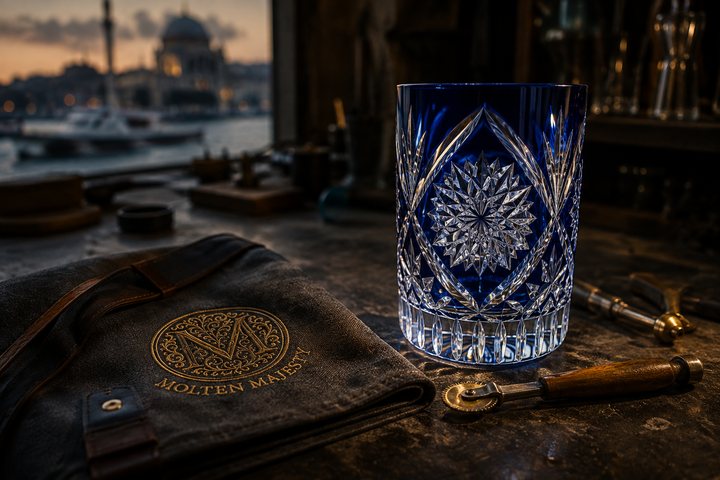
Hand-cut decoration is made after the glass object has been formed and cooled.
The Corning Museum of Glass defines cutting as the removal of glass with rotating wheels. Coarser wheels establish the cuts, while finer wheels and abrasive materials grind and polish the surface. This secondary stage is often called cold working because the material is no longer being shaped in its molten state.
A traditional cut object begins as a blank, meaning an undecorated vessel with enough material to accommodate the planned pattern. The design is marked onto the surface, then developed through successive stages of rough cutting and polishing. Cooper Hewitt describes this as a time-intensive process divided among glassmakers, pattern designers, cutters and polishers.
Hand-cut does not automatically mean handblown. Forming and cutting are separate stages. A machine-formed blank can later receive hand-cut decoration, just as a handblown blank can remain plain.
The label should identify each claim separately.
What is pressed glass?
Pressed glass is formed by placing molten glass in a metal mold and forcing it into shape with a plunger.
The mold controls the exterior pattern, while the plunger establishes the interior. According to the Corning Museum of Glass definition of pressed glass, the interior form can therefore differ from the decorated exterior. Mechanical glass pressing developed in the United States during the early nineteenth century.
Pressing made elaborate surface decoration faster and more repeatable. A pattern that required long hours at the cutting wheel could be reproduced through a mold, bringing heavily decorated tableware into many more homes. Cooper Hewitt notes that pressed glass widened access to ornamental household glass while becoming a collecting field in its own right.
Pressed glass is not an inferior material by definition. It is a production method. A well-designed mold, suitable glass composition and careful finishing can produce a convincing object.
The question is how it was made, not whether it deserves to be invited to dinner.
Hand-cut and pressed glass at a glance
| Feature | Hand-cut glass | Pressed glass |
|---|---|---|
| How the pattern is made | Material is removed from cooled glass with wheels and abrasives | Hot glass receives its form and pattern inside a mold |
| Pattern depth | Can vary deliberately with the wheel and design | Usually follows the fixed depth of the mold |
| Interior surface | May or may not echo the exterior decoration, depending on the blank | Often smoother and independent of the exterior pattern |
| Seams | Cutting itself creates no mold seam | Multipart molds may leave narrow seam marks |
| Repetition | Small variations may appear across motifs | Repeats the mold geometry closely |
| Finishing | Cuts require grinding and polishing | Seams and surface marks may be ground or fire polished |
| Identification | Requires several clues and, ideally, provenance | Requires several clues and, ideally, provenance |
Begin with the pattern, not the sound
Turn the object slowly under a side light.
A hand-cut groove enters the surface. Its walls and base were made by removing material, so the decoration often has a definite internal geometry. Deep diamonds may meet at narrow ridges. Fans may contain cuts of different widths. Long mitres may change direction as they approach the curve of a bowl.
A molded pattern tends to appear raised or recessed according to the shape of the mold. Its transitions may feel softer, especially where the design imitates the intersecting grooves of traditional cut glass. This is useful evidence, though wear and polishing can soften genuinely cut edges as well.
The familiar sound test has enjoyed a long career because tapping a glass is pleasantly theatrical. It says little about whether a pattern was cut or molded.
Composition, thickness, shape and condition all affect sound. Use the eyes and fingertips first.
Look at how the pattern meets the form
The most revealing area is often where the pattern has to solve a problem.
On a round bowl, repeating diamonds cannot continue at the same width indefinitely. They must expand, narrow or meet another motif. Around a pedestal, the decoration must decide where the bowl ends and the supporting form begins.
A cutter can respond to these changes while working. One cut may be deepened to maintain visual weight. A motif may be adjusted where the circumference tightens. The variations should remain controlled, but they need not be perfectly identical.
A pressed pattern repeats whatever was built into the mold. It can be beautifully planned, though its logic is established before the molten glass enters. The same transitions will usually recur with close regularity from one example to the next.
This is why a pattern should be read across the whole object. Examining one diamond in isolation misses the more interesting evidence.
Check the interior surface
The interior can help distinguish pressed glass from a piece whose exterior was cut after forming.
On many pressed vessels, the decorated outer surface is paired with a comparatively smooth interior because the mold and plunger form separate surfaces. Cooper Hewitt identifies this smooth interior as one characteristic of pressed vessels.
On a deeply cut bowl, the pattern has been ground into the outside wall. The interior may remain smooth because the cutter never worked on it, but the relationship between the wall thickness and the exterior cuts can often be seen when the bowl is held toward the light.
This clue is strongest on open bowls, dishes and tumblers. It may be harder to judge on thick, colored or heavily decorated pieces.
Search for mold seams carefully
A seam mark is a narrow ridge left where sections of a mold meet.
The Corning Museum of Glass notes that well-made pieces may have their seams reduced through grinding or fire polishing. The presence of a seam is therefore strong evidence of mold use. Its absence proves very little.
Check:
- Opposite sides of the body
- The underside of handles
- The foot and lower edge
- Areas where the pattern shifts slightly out of alignment
- Narrow recesses that were difficult to finish
A mold seam is evidence, not a full confession. Mold-blown glass can also carry seams, and a vessel formed in a mold may later be cut by hand. The complete production history may involve more than one method.
Feel the surface without relying on sharpness alone
Hand-cut decoration often feels more decisive beneath the fingertips. The grooves can have narrow ridges and distinct changes in depth.
Pressed decoration usually feels smoother because the design was formed against a mold rather than ground into the finished surface. Older pressed pieces may also show small ripples known as chill marks, caused by hot glass meeting colder metal during pressing. Cooper Hewitt notes that dense lacy patterns were historically used to make these marks less apparent.
Sharpness still needs context.
A hand-cut piece may have been thoroughly polished. Years of handling can soften its most exposed edges. Some patterns use shallow cuts by design. A pressed object may contain crisp detail if the mold and glass were handled well.
Run a fingertip lightly across the pattern. Do not drag a nail through the cuts or test the edge with force. Identification should leave the object in the same condition in which it was found.
Examine the quality of the polishing
Freshly ground glass looks pale and matte until the cut surfaces are polished.
On well-finished cut glass, light enters the grooves cleanly. Large facets may produce broad reflections, while closely spaced cuts create smaller, quicker flashes. Cloudy recesses can result from incomplete polishing, accumulated residue or later surface damage.
Pressed glass can also catch light effectively. The difference is often found in the geometry. A cut facet has been created through removal and polishing. A molded imitation receives its reflective planes from the mold, followed by whatever finishing the maker applies.
Brilliance alone does not prove hand cutting. It reveals how successfully the surface handles light.
Do bubbles, weight or a pontil mark settle the question?
No single folk test identifies hand-cut or pressed decoration reliably.
Weight
Cut objects are often made from substantial blanks because the cutting removes material. Some crystal compositions are also denser than ordinary soda-lime glass. Pressed vessels can be heavy too, particularly when designed to imitate cut tableware.
Bubbles
Small bubbles may occur in glass made through several processes. Their presence does not establish hand production, and their absence does not establish machine production.
Pontil marks
A pontil mark can indicate that a blown vessel was held on a pontil rod during finishing. It tells the reader something about forming and finishing, not whether the surface pattern was later cut or molded.
Sound
A prolonged note may relate to composition, form and wall thickness. It does not reveal whether the decoration came from a wheel or a mold.
Use these details as supporting observations. None deserves the entire case.
Can pressed glass also be crystal?
Yes. The terms describe different properties of the object.
Pressed glass describes the forming process. Crystal glass is defined through material characteristics and regulated descriptions in certain markets. The European crystal-glass directive sets categories according to composition and physical properties, and its annex includes provisions that refer specifically to pressed crystal glass.
Likewise, “hand-cut” does not confirm crystal composition. Glass can be cut without meeting a regulated crystal category.
Product pages, labels and certificates should make these claims separately:
- Material
- Forming method
- Cutting or engraving method
- Place of production
- Handmade stages
A generous cluster of adjectives is not provenance.
How should you inspect an unmarked bowl?
Begin with the object, then look for documentation.
- Study the pattern under side light.
- Compare the exterior decoration with the interior.
- Search gently for seams around the body and base.
- Observe whether repeated motifs vary or repeat with mechanical regularity.
- Inspect the polishing inside deep cuts.
- Check the underside for labels, signatures or engraved marks.
- Compare the piece with documented museum or maker examples.
- Consult a specialist before assigning a maker, date or value.
The final step matters. Production methods can be combined, seams can be removed and patterns can be copied across decades.
A home inspection can establish a reasoned opinion. It cannot manufacture provenance.
From the atelier: precision is more than repetition
A hand-cut pattern should belong to the silhouette beneath it.
The Verdura Pedestal Bowl is described by Molten Majesty as hand-cut with an interlacing geometric pattern. Its broad bowl and raised base require the design to manage two different visual weights: the open body above and the narrower support below.
When assessing work of this kind, look beyond whether every line appears identical. Ask whether the pattern remains composed as the surface turns away, whether the cuts meet cleanly and whether the decoration strengthens the form.
Mechanical repetition can be precise. Hand cutting can be careless. Quality appears when the process, whichever one was used, produces a coherent object.
How should cut and pressed glass be cared for?
Both require protection from impact and abrasive cleaning.
Deeply cut surfaces can hold residue in their recesses, while raised molded details can catch against nearby glassware. Wash pieces separately when the maker recommends hand washing, use a soft cloth and avoid sudden temperature changes.
Molten Majesty’s product instructions for the Verdura and Coronet pedestal bowls specify gentle hand washing with mild detergent, no abrasive cleaners and protection from sudden temperature changes. The exact maker’s instructions should always take precedence over general care advice.
Store the object on its intended base with enough room to lift it without contacting its neighbors. Crystal prefers a little distance. Most dinner guests are simply more diplomatic about it.
The most reliable judgment
Hand-cut glass is identified by accumulated evidence.
Deep wheel-made grooves, thoughtful variations, polished cut surfaces and the absence of molded decoration support the case. A smooth interior, seam marks, chill marks and highly regular molded detail support pressed manufacture.
None of these clues should be promoted beyond its usefulness.
Read the material claim separately from the production method. Inspect the whole object. When maker, date or value matters, documentation should have the final word.