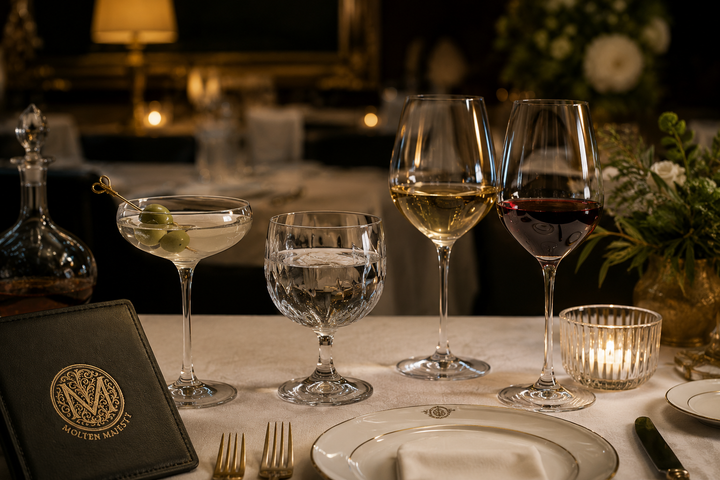
The table is set. The glasses are polished. Still, the room does not feel ready.
Ten minutes before the doorbell rings, the house becomes strangely unfamiliar.
A cushion that has sat happily in the same position all week suddenly looks misplaced. The light above the dining table feels too bright. A serving bowl is moved from the centre of the table to the sideboard, then returned to exactly where it began.
There is always one glass with a mark on it.
The host sees everything at once: the unopened bottle, the corner where coats will gather, the candle that refuses to stand straight. Music is changed twice. A window is opened for thirty seconds and then closed because the room has become too cold.
This brief period has little to do with cleaning. The work is already done. What remains is the quiet construction of an evening.
The room before it belongs to everyone
A home changes when guests enter it.
Until then, every object belongs to the private life of the person who lives there. Books can remain open. Shoes may wait near the door. A half-finished cup of coffee is harmless. Once the first guest arrives, the same room becomes shared territory.
The final ten minutes are spent making that transition.
Personal traces are softened, although never entirely erased. The room should feel composed, but not staged. Too much order can be as uncomfortable as too little. A table that looks untouched may leave guests afraid to disturb it.
The most inviting rooms retain some evidence of life. A chair slightly turned toward another. A bottle already opened. Candlelight that has had time to settle. These details suggest that the evening has begun before anyone arrives.
Good hosting rarely announces the effort behind it.
The table is adjusted by instinct
Even a carefully planned table is judged differently once it is complete.
From a distance, the arrangement may appear balanced. Sitting down reveals other problems. A tall vase interrupts conversation. A decorative object occupies the space needed for bread. The glasses catch no light because they have been placed beneath a shadow.
This is why the final adjustments are so often small.
A crystal bowl is turned until the cuts begin to reflect the room. Water glasses are pulled slightly closer to each place setting. A candle is moved far enough away from the flowers to let both be seen clearly.
Few hosts measure these changes. They feel them.
The table has its own visual weight. Dark glass draws the eye quickly. Clear crystal can almost disappear until it meets light. A wide bowl lowers the centre of the arrangement, while a tall object creates formality. What looks beautiful in isolation may behave very differently once plates, linen and serving pieces surround it.
The best tables leave space for the evening to unfold. They allow for a hand reaching across, an additional bottle, a dish brought out later than planned.
Beauty at the table should survive use.
The good glasses finally leave the cabinet
There is often a moment, shortly before guests arrive, when the host decides whether the evening merits the good glassware.
This decision is rarely practical.
The glasses may be more delicate. They may require hand washing. They may have been bought on a journey, inherited from a relative or kept untouched since their box was first opened.
Yet objects made for the table acquire meaning through repetition. Their history begins with the first pour, then grows through every dinner that follows. A faint memory attaches itself to them: who sat where, what was served, which evening continued long after the candles had burned low.
Saving beautiful glassware protects it from damage, but it also keeps it outside the life it was made to enter.
So the cabinet door opens.
Each piece is checked against the light. A trace of dust is removed from the rim. The glasses are placed carefully, then nudged into less careful positions so the table does not resemble a showroom.
By the time the guests arrive, no one will know how much thought went into them.
That is part of their charm.
The panic no guest ever sees
At six minutes to the hour, something usually goes wrong.
The ice has not been taken out. The bread has been forgotten. A message arrives from someone who is running late, followed immediately by another guest announcing that they are early.
The host moves faster, while trying to make the room appear calmer.
This is the contradiction at the centre of hospitality. Effort must be concealed at the exact moment it reaches its peak. Guests should feel expected, but never burdensome. They should find the room ready, without feeling that it has been waiting stiffly for their arrival.
The final task is often the host themself.
An apron is removed. Sleeves are adjusted. The expression changes. The mental list of unfinished details is briefly set aside.
Nothing is ever entirely ready. The sauce could be warmer. The flowers could be lower. One place setting is probably missing something.
Then the bell rings.
The door opens, the private rehearsal ends and the house becomes generous.
Within minutes, glasses are lifted from their carefully chosen positions. Napkins unfold. Someone places a phone beside a plate. The table loses its symmetry and gains a life of its own.
This is what all those final adjustments were preparing for.
Not perfection. Arrival.